
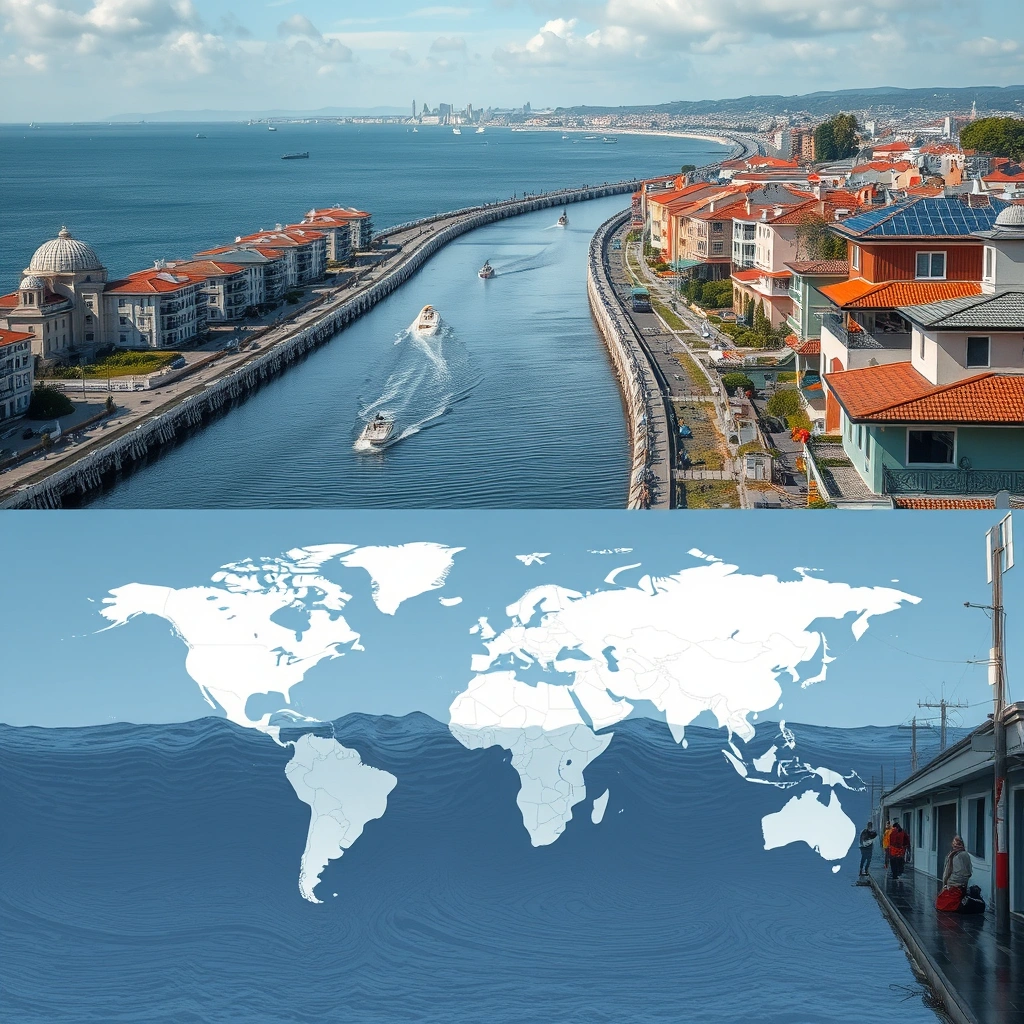
From the sinking streets of Jakarta to the armored seawalls of New York, the escalating impact of climate change is no longer a distant threat but a present reality. This year, a confluence of scientific reports and extreme weather events has placed the issue of rising sea levels at the center of global politics, forcing nations to confront a new era of environmental and geopolitical transformation.
Recent data from the Intergovernmental Panel on Climate Change (IPCC) indicates that global mean sea levels could rise by up to one meter by 2100 if current emission trends persist. However, the most alarming projections come from the Antarctic and Greenland ice sheets, whose potential collapse could add several more feet, threatening the existence of entire island nations like Kiribati and the Maldives.
The response from the international community has been a mix of urgency and adaptation. The Netherlands, long a pioneer in water management, has unveiled its ‘Room for the River’ program expansion, which involves creating floodplains and relocating dikes to work with nature rather than against it. Meanwhile, in Southeast Asia, Indonesia has announced the relocation of its capital from Jakarta, which is sinking due to groundwater extraction and rising seas, to the forested island of Borneo.
Geopolitically, the shifting coastlines are redrawing maritime borders and resource claims. In the Arctic, melting ice is opening new shipping routes and access to oil and gas reserves, sparking a new ‘cold war’ among nations including Russia, Canada, and Denmark. In the Pacific, rising waters are legally redefining what constitutes an exclusive economic zone, as island states argue that their maritime territories should remain fixed even if their land disappears.
The financial burden is enormous. A recent World Bank report estimates that adaptation costs for developing coastal nations could reach $500 billion per year by 2050. To meet this, the Green Climate Fund, established under the UNFCCC, is channeling billions into projects from mangrove restoration in Bangladesh to floating agriculture in Vietnam. Yet, there are calls for a new global fund, similar to the COVID-19 response, to address the urgency of what some leaders call ‘climate apartheid’.
Local innovation is also flourishing. In Lagos, Nigeria, entrepreneurs are building floating schools and homes using recycled plastic. In Miami, architects are designing ‘climate-resilient’ skyscrapers with amphibious foundations. And in Rotterdam, the city has constructed a massive underground parking garage that doubles as a water storage facility.
Despite these efforts, the path forward remains fraught. The latest UN climate summit in Baku failed to produce a concrete commitment to phase out fossil fuels, and the United States, under its new administration, has once again signaled a pullback from international climate agreements. As the tide rises, so too does the urgency for a coordinated global response.